

Have you ever wondered about the role of participios (participles) en español? Then join us for an easy & practical review of this important part of the Spanish language!
¿Qué son los participios? The participios are non-personal forms of Spanish verbs; this means that they cannot be conjugated, they are not singular or plural, and they are not femenine or masculine.
To form regular participles we replace the end of -ar verbs for -ado and of -er / -ir verbs for ido:
- Cantar –> cantado
- Comer –> comido
- Vivir –> vivido
On the other hand, los participios irregulares end in -cho and -to: 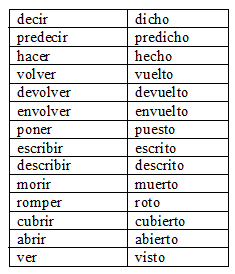
Uses:
1) Participio as adjetivo:
When used as an adjective, the participio changes in gender (femenine/masculine) and number (singular/plural), depending on the sustantivo (noun) it’s modifying.
- La puerta está cerrada porque ahora hace mucho frío. The door is closed now because it’s too cold.
- El vaso está roto, ten cuidado que puedes cortarte. The glass is broken; be careful or you might cut yourself.
- Ella caminó con los ojos cerrados para recibir la sorpresa que le preparó su familia. She walked in with her eyes closed to receive the surprise prepared by her family.
- El sábado pasado jugamos la última jornada de la liga de fútbol. Last Saturday we played the last game of the soccer league.
As an adjective, we can also use it with voz pasiva (passive voice):
- Las mesas fueron hechas por el mejor carpintero de la ciudad. The tables were built by the best carpenter in town.
- El café es preparado por mi padre. The coffee is made by my father.
- Este libro fue escrito por Mario Vargas Llosa. This book was written by Mario Vargas Llosa.
2) Participio as sustantivo:
When working as a noun, el participio can be masculine or femenine:
Masculino: el hecho, el dicho, el puesto, el vuelto, el muerto.
Femenino: la entrada, la salida, la llegada, la vuelta, la muerta.
3) Participio as verbo:
In this role, el participio works together with the auxiliary verb haber to form the compound verbal tenses: Pretérito perfecto, pretérito pluscuamperfecto, futuro y condicional perfectos.
- Ellos se han comprado un nuevo coche. They have bought a new car.
- Cuando nosotros entramos en la clase, la profesora ya había comenzado la exposición. When we arrived to the class, the teacher had already begun the exposition.
3) Participio as conjunción:
Sometimes we can find el participio in certain conjunctions, such as: dado (que), visto que, debido a
- Debido a la abundante lluvia… Due to the heavy rains…
- Toda la gente salió corriendo del centro comercial dado que hubo un ruido muy fuerte. Everyone ran out of the mall because there was a very loud noise.
- Nosotros nos fuimos del bar visto que ustedes no llegaron. Since you never showed up, we left the bar.